Cartridge Guns vs. Dispensing Systems: When Does Upgrading Pay Off?
Many manufacturers start processing adhesives and sealants with cartridge guns. That makes sense: the barrier to entry is low, the investment is manageable, and for small quantities the system works reliably. But beyond a certain consumption level, the equation reverses.
This article shows where the economic and process-related boundary between cartridge guns and dispensing systems lies, and which factors play a role in the decision.
The following video summarises the key points in just under two minutes:
How cartridge guns work
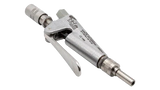
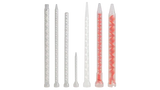
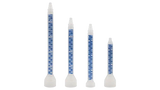
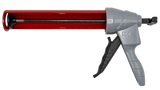
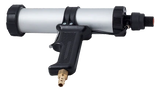
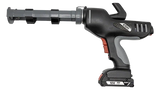
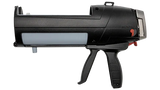
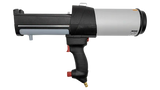
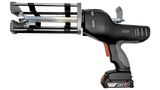
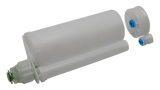
A cartridge gun dispenses adhesive or sealant directly from a pre-filled cartridge. The operator inserts the cartridge, operates the gun manually, pneumatically or by battery, and applies the material through a nozzle or a static mixer.
The system is particularly suited for:
– small to medium consumption volumes
– changing materials or small batches
– mobile use or repair work
– applications without high demands on repeatability
How dispensing systems work
A dispensing system feeds material from bulk containers – typically 20-litre pails or 200-litre drums. The material is drawn by drum or follower plate pumps and metered precisely via piston or gear pumps. In 2K applications, both components are combined at the defined mix ratio through a static mixer.
The system is particularly suited for:
– high or regular consumption volumes
– series production with consistent requirements
– applications with tight tolerances on mix ratio and shot size
– automated or semi-automated production lines
The decisive factor: material cost per litre
The biggest economic lever when upgrading is not the machine itself, but the material price. Adhesives and sealants in cartridges cost several times more per litre than the same formulation in a drum.
A typical example:
– 310 ml cartridge: approx. €8–15 → equivalent to approx. €25–48 per litre
– 200-litre drum: significantly cheaper per litre depending on the material
The exact difference depends on the specific adhesive and supplier. In many cases, the per-litre price from a drum is a fraction of the cartridge price. This difference grows with every unit consumed.
Additional cost factors
Beyond the pure material price, several other factors come into play:
– Changeover time: Every cartridge must be inserted, vented and replaced after use. At high throughput, this effort adds up significantly.
– Material waste: Every cartridge retains a residual volume that cannot be fully dispensed. Dispensing systems with follower plates empty the container almost completely.
– Packaging disposal: Empty cartridges generate waste that must be disposed of.
– Operator dependency: Cartridge guns require more manual intervention. Dispensing systems operate largely automatically and deliver repeatable results regardless of the operator.
– Output rate and cycle time: A dispensing system delivers significantly higher output than a cartridge gun. In series production, this reduces the cycle time per part considerably.
Process-related differences
Beyond economics, the two systems also differ in achievable process quality:
– Repeatability: A dispensing system delivers the same material quantity with every shot. With a cartridge gun, the result depends more heavily on the operator.
– Mix ratio (for 2K): Dispensing systems maintain the mix ratio via pumps and optionally via volume measuring cells. With 2K cartridges, the mix ratio is determined by the cartridge geometry, but there is no in-process monitoring.
– Documentation: Dispensing systems with controls record process parameters such as pressure, volume and mix ratio. This data is increasingly required in quality-critical applications in the automotive, rail and aerospace industries.
At what volume does upgrading make sense?
A blanket answer is not possible, as the decision depends on several variables: material price, consumption volume, cycle time, quality requirements and labour costs. In practice, however, some guidelines can be derived:
– With regular consumption of more than 5–10 cartridges per day, an economic evaluation is worthwhile in most cases.
– For 2K applications with tight tolerances, upgrading often makes sense even at lower volumes, as process reliability becomes the deciding factor.
– In series production with a consistent material, a dispensing system typically pays for itself within a few months through the material cost difference alone.
What to look for when choosing a supplier
A dispensing system is an investment in your production capability. Accordingly, the critical question is what happens when the system is down. Because production downtime quickly costs more than the system itself.
In practice, the difference between suppliers shows in three key areas:
– Responsiveness: Can you reach service at short notice when a problem occurs?
– Spare parts availability: Are spare parts in stock and available for immediate dispatch, or do you wait days or weeks?
– Service expertise: Is the problem resolved promptly by phone, remote access or on-site technician visit?
At t-s-i.de, we keep all standard spare parts in stock at our warehouse in Waldmohr, Germany. Our service team is available by phone, remote access and on-site if needed. Over 2,500 installed systems worldwide demonstrate that this model works.
What the transition looks like in practice
Switching from cartridges to a dispensing system requires some preparation:
– Material approval: The adhesive must be available in the required container size (pail or drum) and approved by the manufacturer. As a rule, adhesive manufacturers such as Sika, Kömmerling or Otto Chemie supply the same formulation in different container sizes.
– Application adaptation: Dispensing nozzle, mixer and output rate must be matched to the new system.
– Commissioning and training: The system is commissioned on-site by a service technician, and operator training is provided.
Conclusion
Cartridge guns are the right tool for small quantities, flexible use and getting started with adhesive processing. Once consumption volumes, quality requirements or cycle times increase, a dispensing system becomes the more economical and process-reliable solution.
Want to know if upgrading makes sense in your case? Use our enquiry form to describe your material and application. We will get back to you within 1–2 working days with an initial assessment.